Last post I stripped half the frame with a surface conditioning wheel and showed you that silver line where the weekend ran out. The plan was always to follow the wheel with a media blaster to reach everything the wheel could not, the seams, the corners, the tight pockets. This weekend I picked up the blast nozzle for the first time in my life.
I have a confession. It is harder than it looks. A lot harder.
What the videos do not tell you
On every restoration video, sandblasting looks like a magic wand. Point it at rust, rust disappears, move on, done by lunch. What those videos edit out is that you are working inside a cloud of dust so thick you can barely see the metal you are trying to clean, holding a heavy nozzle that kicks back against your hand, in a hood, sweating, while media ricochets off everything and the surface reveals itself one slow square inch at a time.
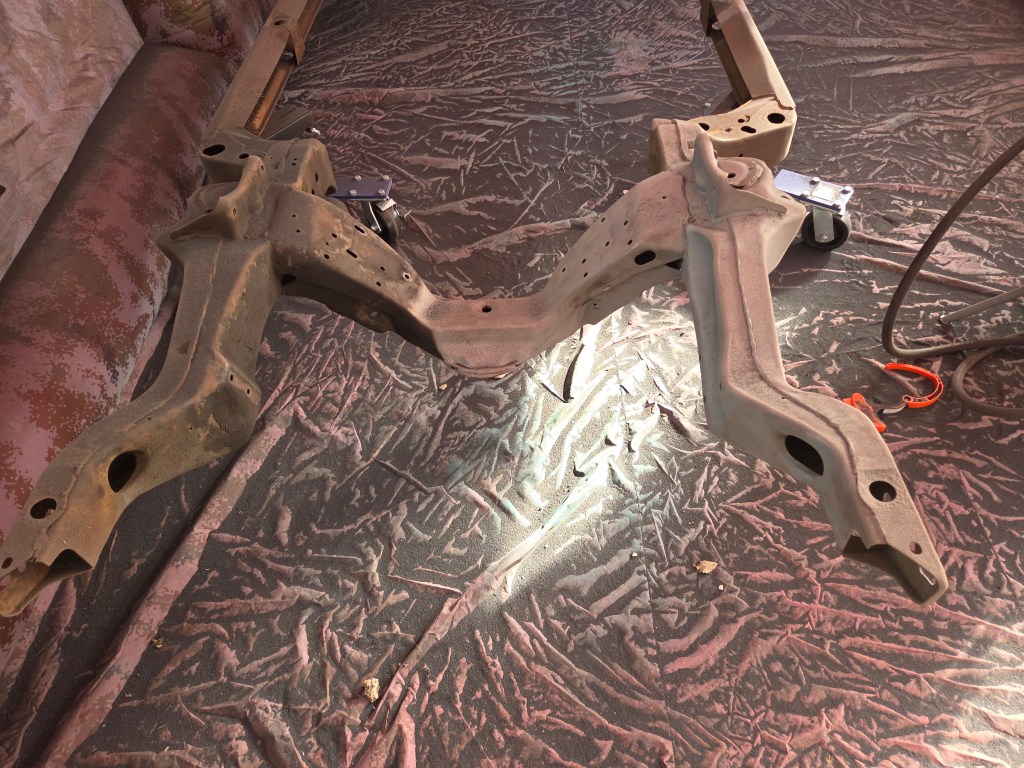
Forty minutes in, dinner called, and this is how far I got. The front crossmember and the front rail came to that even uniform gray, which is exactly the color you are chasing, bare steel with every trace of scale and rust gone. But forty minutes for that much, on my first try, taught me real respect for the guys who blast frames for a living.
What I figured out, live
The good news is that it started clicking by the end. A few things turned it from a fight into something closer to a rhythm.
The biggest one was the media valve. My first instinct was to open it all the way, more sand equals more cutting, right? Wrong. Wide open just dumps so much media into the air that it chokes the stream and throws those giant useless clouds, and you cannot see a thing. I dialed the sand valve back to about sixty percent and ran 90 PSI, and suddenly it was a steady controlled spray that actually cut, instead of a dust storm that did not. Less media moving faster beats a flood of it moving slow. That one adjustment changed the whole session.
The other lesson was humbler. I started blasting before the booth floor was clean, which means the media I just used is now full of dirt and debris and cannot be reused. Good blasting media is not cheap and it is designed to be recovered and run again several times, but only if you keep it clean. Lesson learned. Next session, the booth gets blown out and swept first, and that next box of media gets to live a longer life.
The booth doing double duty
That is all happening inside an inflatable paint booth, 20x13x9, which will eventually be where this car gets its color. For now it is earning its keep early as a blast containment tent, keeping media off the rest of the shop and out of the driveway. Buying it now instead of at paint time meant it starts paying for itself months ahead of schedule.
Slow is still forward
I will be honest, forty minutes of work for one front section felt slow while I was doing it. But that is how every new skill goes. The first frame is tuition. By the time I have worked back to the rear rails and the kickups, my hands will know the gun, the valve will already be dialed, and the whole thing will move at twice this pace.
The frame is coming to bare metal. Not fast, not pretty, but honest and thorough, which is the only way that matters. Next stop, the rest of the rails, then the metal work, and then this thing finally starts wearing black.
More soon.


Leave a Reply