I almost did not post this one, because on paper not much happened this weekend. No parts came off. Nothing got welded. I did not even finish the job I started.
And then I looked at the photo and realized it might be the best before and after on the whole build so far, because it is a before and after in a single frame. Same piece of steel, same afternoon, one tool.
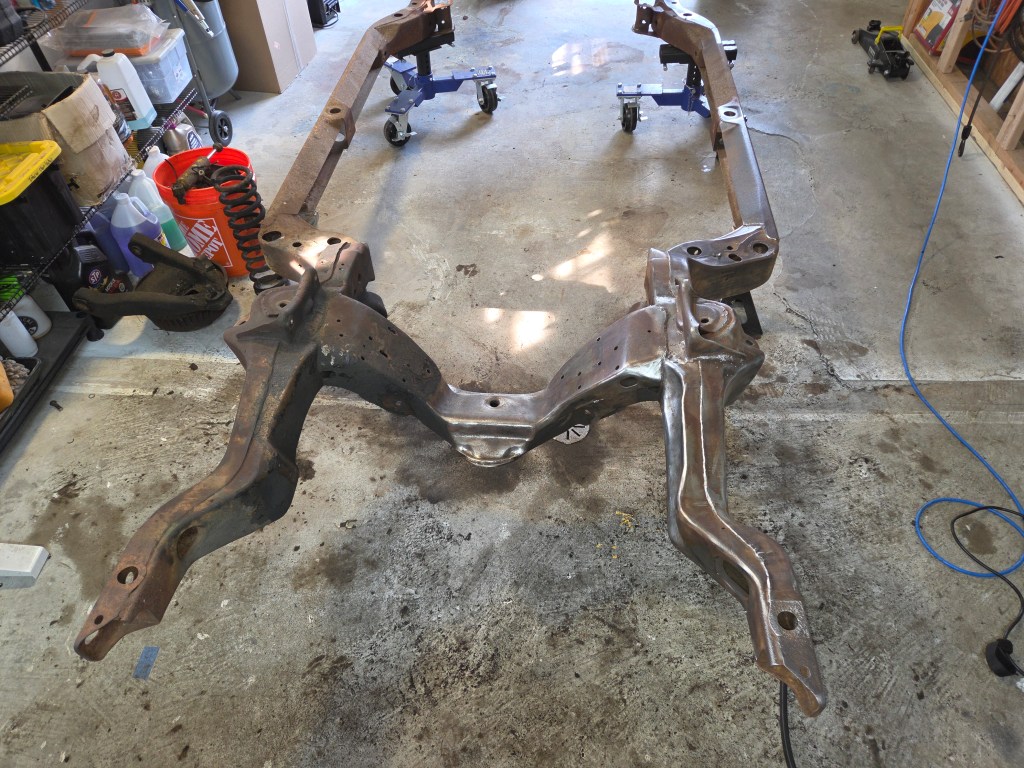
Look at that front crossmember. Bright, swirled, honest steel, catching the light like it just left the mill. Now look up at the rails behind it, still wearing the rusty tan they have worn since the Nixon administration. That line where silver meets brown is exactly where I ran out of weekend. Everything below it got the tool. Everything above it is waiting its turn.
The tool that drew that line
The bright metal is the work of an Eastwood Contour SCT, the surface conditioning tool. If you have never used one, picture a big eraser wheel that spins against the steel and lifts grime, scale, and light surface rust off in a cloud of dust, leaving that swirled bare finish behind. Unlike a hard grinding wheel, it does not gouge or dig into good metal, so you can lean on it across a big flat panel or a frame rail and take off the ugly without eating the steel underneath. On a crusty fifty seven year old frame it is the difference between a weekend and a month. It is the first real pass of frame restoration, the step that turns a rusty relic back into something you can actually build on.
It is also slow, dirty, arm numbing work that photographs like almost nothing, right up until that silver line, where it suddenly photographs like everything.
Why the SCT is only round one
Here is the honest part, because this log does not oversell. That bright crossmember is not done. It is just started.
The SCT is brilliant on flats and open curves, but it cannot reach into the pinch weld seams, the tight inside corners, or down into the boxed sections of the rail where rust likes to hide from daylight. That is what the media blaster is for, coming next, to take the whole frame to true uniform bare metal in every crevice the wheel could not touch. SCT for the big open real estate, blaster for the detail. They are a team, not rivals.
And before a single drop of finish goes on, two things happen while the metal is naked and talking. First, the hunt for the factory frame stamp, somewhere on these rails, before the blaster erases it forever. Second, the interrogation, a sharp pick pressed hard into every boxed section to prove the steel is solid all the way through and not just pretty on the outside.
The plan to make it last another fifty seven years
Once the frame is blasted clean and proven solid, the order of what goes on it matters as much as the products themselves. Here is the system, and why each piece is on the bench.
First, the metal work. Boxing plates get welded into the open sections of the rail while the steel is still bare, because weld heat and fresh paint are enemies. All the grinding and welding happens before any finish goes down. Coat first and you just burn it back off around every weld.
Then the inside of the rails, where these frames actually die. An A body frame does not rot from the outside where you can see it. It rots from the inside of the boxed sections, where moisture gets in through drain holes and never fully leaves. You can have a frame that looks perfect on the outside and is lace on the inside. So the cavities get treated with two products working together.
Eastwood Rust Encapsulator goes first on any interior surface rust the blaster could not reach. Encapsulator is built for exactly that situation, light surface rust you cannot fully remove. It wets down into the oxidized steel, penetrates, and locks it down so it cannot keep spreading, then cures into a hard sealed film. It is not paint you slap over rust and hope. It is a chemical handshake with the rust that stops it in place.
Then Eastwood Internal Frame Coating goes down inside the rails through the factory access holes. This one ships with a long flexible wand that snakes into the cavity and fogs a phenolic resin coating with a zinc additive across every inside surface, the ones no brush or blaster will ever touch. Zinc is the same corrosion fighter galvanizing uses. This is the step most restorations skip because nobody sees it, and it is the step that decides whether this frame is still solid in another fifty years or quietly rotting from within.
Then the outside gets its finish. With the inside sealed and the welding done, the exterior gets Eastwood Chassis Black in gloss. It is a tough, self leveling chassis finish made to live under a car, shrug off stone chips and road grime, and still look sharp doing it. This frame has spent fifty seven years turning brown. Chassis Black is where it goes black for good.
Belt and suspenders, in the right order. Encapsulator stops any rust that survived. Internal coating seals the cavities that kill these frames. Chassis Black armors the outside. Each product doing the one job it is actually built for.
The silver line moves
That is a lot of steps hiding behind one weekend that looked like almost nothing. But that silver line in the photo is the whole project in miniature. On one side, an old rusty frame. On the other, the car this is going to be. And every weekend from here, that line moves.
More soon.
 Anchor Point Iron - Classic Car Restorations and Customizations
Leave a comment