Why Write This at All
Because education is important. That is the whole reason this site exists.
Seriously. If you are reading this page and following this build, more than likely you are trying to learn something, and maybe apply it to a build of your own. Or you just love classic cars and want to understand them better. Either way, you are in the right garage, because this post is for you.
Here is the thing about clones: every popular make and model gets cloned. This is not an Oldsmobile problem. Chevelles become SS396s. Novas become Yenkos. Mustangs become Bosses and Shelbys. Road Runners grow Hemi badges. Anywhere a hero car exists, regular cars get dressed up as one, and the 442 is no exception. Some of those cars are honest tributes built by people who tell you exactly what they are. Some of them are wearing a costume and a price tag to match. Learning to tell the difference is a skill, and like every skill in this hobby, somebody has to show you where to look.
And here is what that skill actually buys you. It is not just about protecting yourself when there is money on the table, though it absolutely does that. Knowing an honest car from a clone changes how you walk a car show. You stop taking badges at face value and start reading the whole car. You notice the frame, the tag, the arms, the numbers, and the car starts telling you its real story, which is usually more interesting than the one on the windshield card. It even changes the conversations. Ask an owner about his boxed rails instead of his badges and watch the talk get real in a hurry. The guys with honest cars light up. The other guys change the subject.
So that is what this post is. Part one is why this build will never wear badges it did not earn. Part two is the VIN truth every old timer tells you, which holds for most of the 442’s life, except for the four years it does not, and those happen to be the four years everybody wants. Part three is the mirror test, the chassis evidence that cannot be faked, and the cover ups people use to try anyway. Grab a coffee. By the end you will walk a show field different.
Part One: Why This Build Is Not a 442 Clone
Everybody clones a 442. Walk any Olds show and half the “442s” on the field started life as a Cutlass or an F 85, and somewhere along the way somebody swapped the badges, painted the stripes, and started telling people a story. I get why. The 442 is the hero car. But that is exactly why I am not doing it. When everyone builds the same tribute, the honest car becomes the rare one.
This car is a 1969 Cutlass S, built in Oshawa, and it will say Cutlass on the fenders when it is done. Not because I could not fake it. Because I do not want to. A build should not open with a lie, and a clone that introduces itself as the real thing is lying to every person who walks up to it at a cruise night.
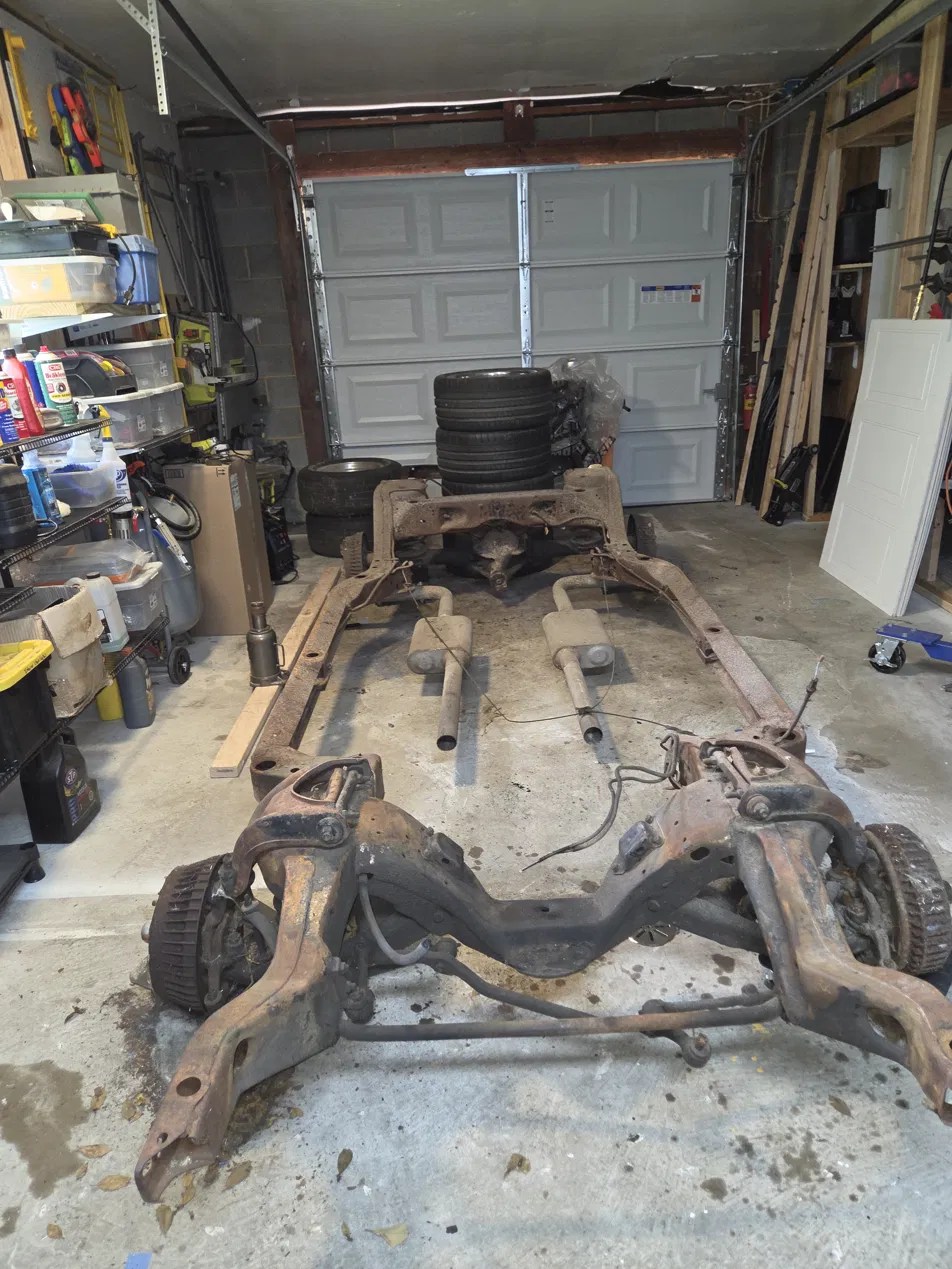
Here is the thing the badge swappers forget. The frame does not lie. Real 442s ran fully boxed frame rails from the factory. A hardtop Cutlass like this one runs open channel rails, and no amount of stripes and emblems changes that. Anyone with a mirror and ten seconds can slide it under the rocker and read the truth, no VIN decoder required. Every clone on the show field fails that test. So why pretend? The frame already told everyone what the car is. I would rather the fenders agree with it.
Will I borrow from the 442 parts bin? One piece, and I will say so right here: the grille. There is a 442 nose on the shelf because I think it is the better looking front end Oldsmobile drew that year, and hot rodding has always been about running the parts you like. But borrowing a grille and impersonating a car are two different things. The badges stay Cutlass. This build is going to be exactly what it is: a clean, honest, Oshawa built Cutlass S with a strong Rocket 350, done right in the open where everyone can watch. No costume required.
Part Two: The VIN Truth, Except When It Is Not
If you have spent any time around Oldsmobiles, somebody has told you the VIN cannot prove a 442. I was told the same thing. And here is the thing: for most of the 442’s life, that advice is dead right.
From 1964 through 1967, the 442 was not a model. It was an option package on the F 85 and the Cutlass. Check the box, get the package. The VIN on those cars reads like any other F 85 or Cutlass that rolled down the line, because as far as the VIN system was concerned, that is exactly what they were. Proving an early car is real means paperwork: the build sheet, the original invoice, the Protect O Plate, dealer documentation. No paper, no proof, and plenty of early “442s” have changed hands on nothing but a story.
Then in 1972 Oldsmobile did it again in reverse. The 442 went back to being an option, the W 29 appearance and handling package on the Cutlass. The VIN goes quiet again. A 1972 VIN does carry an engine code, which helps narrow things down, but it cannot prove the package. Back to the paperwork.
So the old timers telling you the VIN will not help? They are right for 1964 through 1967 and right again for 1972. But there is a window where they are wrong, and it happens to be the window everybody wants: 1968 through 1971, the 442 was its own series, and the VIN says so right up front.
For those four model years, a real 442 VIN starts with 344. First digit 3 for Oldsmobile, then 44 for the 442 series. A Cutlass S like mine starts with 336. No decoder ring, no expert, no paperwork required. Read the first three digits and the car tells you what it is. The next two digits give you the body: 87 for the Holiday hardtop coupe, 77 for the pillared sports coupe, 67 for the convertible. Then the model year, the plant, and the sequence number.
The Fisher body tag on the cowl backs it up. A 1969 442 Holiday coupe reads style 34487 where my Cutlass S reads 33687. But a word of caution here: cowl tags unbolt. A VIN is riveted, stamped, and tied to the title, and swapping one is fraud, not restoration. If a tag and a VIN disagree, believe the VIN and walk away from the car.
While we are in that window, know what a real one carried. In 1968 and 1969 the 442 came standard with the 400 cubic inch Rocket at 325 horsepower, with the W 30 forced air cars rated at 360. In 1970 the 455 became the standard engine, 365 horsepower with the W 30 at 370, and that is the peak of the mountain. In 1971 the 455 stayed but compression dropped hard for low lead fuel, and the numbers fell with it. So a “1969 442” with a factory 455 story, or a 350 wearing 442 badges, has some explaining to do before anyone talks money.
Bottom line: for a 1968 to 1971 car, the VIN answers the question in three digits. Everything else, we settle in part three, with a mirror and ten seconds under the rocker.
Part Three: The Mirror Test, and Why Nobody Clones the Chassis
The VIN settles a 1968 to 1971 car in three digits. But VINs get argued about, titles get washed, and for the early cars and the 1972s the VIN never talks at all. So you go underneath. And here is why underneath works: cloning happens from the outside in. Badges, stripes, a hood, maybe a bigger engine. Nobody buys a real 442 frame and chassis and then goes hunting for a Cutlass body to drop on it, because by then you have spent real 442 money to build a fake 442. The chassis stays Cutlass on nearly every clone ever built. Which means the factory differences under the car are still down there, telling the truth, and everything a cloner does about it is a cover up you can learn to spot.
Start with the frame, because it does not unbolt. Real 442 hardtops ran fully boxed frame rails. A garden variety hardtop Cutlass or F 85 runs open channel. Slide a mirror under the rocker and look at the inside face of the rail. If you can see into the channel like a piece of angle iron, you are looking at a Cutlass no matter what the fenders say. Ten seconds, no tools. One honest caveat: convertibles got boxed frames regardless of model, so on a drop top the frame test proves nothing either way. On a hardtop it is close to everything.
Now the cover ups, because they exist. A determined faker can weld plate into an open channel rail and box it himself. Factory boxing is clean, continuous, and wears the same half century of grime as the rest of the frame. Homemade boxing shows weld seams, plates that stop and start, and metal that does not age match its neighbors. Which brings up the biggest red flag under any car being sold as real: fresh, thick undercoating on the rails. Undercoat is honest rustproofing on a driver. On a car wearing a big price and a bigger story, it is also exactly how you bury weld seams. If the frame story matters to the money, you want to see metal, not tar.
Full disclosure, because this site does not run any other way: this very build is welding boxing plates into its own mid rails. Chassis stiffness for the coilover suspension, done in the open, photographed at every step, on a car that will never claim to be anything but a Cutlass S. That is the whole difference in one example. Boxing your rails for performance and saying so is hot rodding. Boxing your rails and burying the welds under fresh undercoat so the car can wear a 442 price tag is fraud. The work is not the sin. The silence is.
Next, the suspension, because the factory built the 442 chassis different at both ends and almost no clone chases all of it. Up front a real car carried the heavy duty setup: a thicker front sway bar and stiffer springs than a base Cutlass. Out back is the famous one: a rear sway bar, mounted to boxed lower control arms, because the open channel arms on a regular Cutlass flex and crack under sway bar loads. The factory pairing is the evidence: boxed lowers, correct bar, correct brackets, all wearing the same age.
And here is where sellers get clever, so pay attention. Aftermarket tubular control arms, uppers and lowers, are cheap, common, and sold in every catalog with sway bar mounts already welded on. A guy bolts tubular arms into his Cutlass, hangs a bar off them, and now the underside looks the part at a glance. What he actually did was throw the factory arms in the scrap pile, and the factory arms were the witness. Aftermarket arms do not prove the car had a bar. They prove somebody bought arms. Same goes for a bolt on rear bar clamped to original open channel arms, which is its own tell, because the factory never did that, and given enough miles the cracked arms will say so. On any car being sold as a real, unmolested 442, a freshly upgraded suspension should slow you way down. Upgrades are fine on a driver. They are also exactly how you erase what a car never had. When the arms are gone, go back to what cannot be bought at a swap meet: the frame, the VIN, and the numbers.
Which brings us to the drivetrain. In 1968 and 1969 a real 442 means a 400 cubic inch Rocket, in 1970 and 1971 the 455. The block carries casting numbers that date it, and on a numbers matching car it wears a partial VIN stamp matching the car it sits in. A 350 under 442 badges is a clone announcing itself. A correct displacement block cast a year after the car was built is a replacement engine, which is honest wear on a driver and a price conversation on a numbers matching sale. If someone claims W 30, the bar goes higher: forced air setup, the hotter cam and heads, and on the 1969 cars the famous red plastic inner fenders. W 30 money demands W 30 proof.
Round it out with the supporting cast: heavy duty cooling, the correct rear axle and its codes, and the holy grail paper, meaning the build sheet tucked above the tank or under the carpet, the Protect O Plate, the original invoice. No single item proves a car. Together with the frame and the VIN, they close the case.
That is the whole toolkit. Three digits up top, a mirror underneath, and a healthy suspicion of anything shiny and new on a car being sold as untouched. The 442 earned its legend honestly. The least the rest of us can do is talk about our cars the same way.
Where This Goes From Here
This post is the foundation. In the coming installments we are going to take it under the car with a camera. Side by side shots of boxed rails next to open channel, exactly where to put the mirror and what you are looking at when you do, factory boxed lower arms next to catalog tubular arms, Fisher tags, casting numbers, the works. Reading about the tells is one thing. Seeing them in pictures, on real metal, is how it sticks. That is where this series goes next.
And along the way I want to make a case that does not get made enough: a 442 and a Cutlass S are both beautiful cars. They share the same body shell. Same roofline, same haunches, same stance. Strip the badges off both and park them side by side, and nobody walking past picks a winner. The 442 legend was earned with the drivetrain and the chassis, not the sheet metal, because the sheet metal was already right. The S does not need a costume. It showed up wearing the same suit.
And realistically? A daily driver does not need to be a W 30, a W 31, or a 442 drinking gas at four dollars a gallon. Those cars were built to win stoplight wars, and they are glorious at it, and the fuel bill is part of the legend. But a strong Rocket 350 in the same gorgeous body gives you the lines, the presence, the sound, and a car you can actually drive to work without wincing at the pump. That is not settling. That is choosing the right tool and being honest about the job, which, if you have read this far, you already know is the whole point of this build.
Cutlass on the fenders. Honest to the frame. See you under the car.
 Anchor Point Iron - Classic Car Restorations and Customizations
Leave a comment